
Mental Health and Preventive Care: An Interview with Emma Christensen, MA, LPC
At TMC, behavioral health is part of your preventive care journey. You don’t have to navigate a separate system or wait until things feel unmanageable. Support can begin right in the room, alongside your provider.
In mountain towns, especially during shoulder seasons, stress can take on its own rhythm. Routines change, familiar faces may not be as present, and the slower pace can create space for stress to surface. At the same time, broader “world stress” continues in the background. Together, these layers can leave people feeling stretched thin, disconnected, or overwhelmed.
At Telluride Medical Center, we see how often mental health shows up in subtle ways first. It might look like trouble sleeping, low energy, irritability, or difficulty focusing. These are often early signals and addressing them as part of preventive care can help keep them from building into something more difficult to manage.
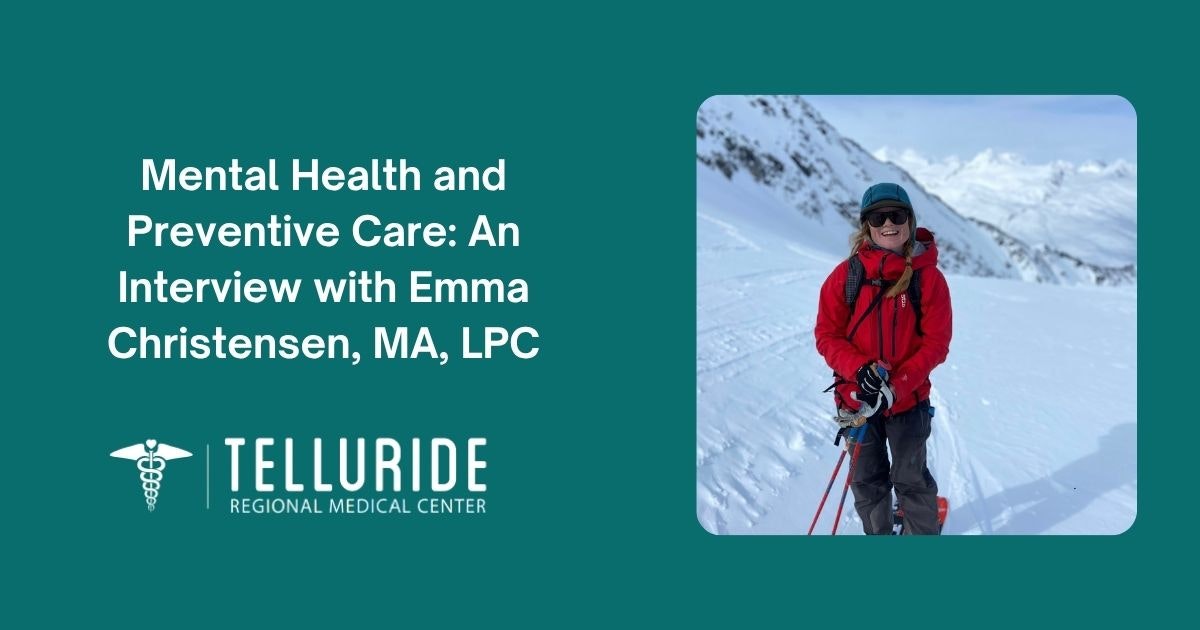
We spoke with Behavioral Health Counselor Emma Christensen, MA, LPC, to better understand how these services support patients in real time:
Q: How do you see “world stress” and “town stress” impacting patients, and how can people cope with both at once?
A: Managing life stressors can feel overwhelming and helpless at times. You might notice an impact on your sleep, your relationships, or feeling drawn to distract or avoid certain feelings. Seeking support through TRMC can be a great start in identifying means to cope nad finding sources for support.
Q: Many people feel stuck between disconnection and overwhelm. How do you help patients move back toward connection?
A: We support our patients in understanding the impact of what they are navigating. We provide short-term or long-term support in helping patients connect with their internal experience through evidenced based therapeutic modalities.
Q: What are some early flags or signs that stress is starting to impact someone’s mental health?
A: Some early flags or signs that stress is starting to impact someone’s mental health would be noticing an impact on sleep or relationships, feeling drawn to avoid or distract (i.e. with substances or screen time), or noticing reduced interest in things you once enjoyed.
Q: Can you explain how a “warm hand-off” works during a primary care visit, and what patients can expect in that moment?
A: A warm hand-off is an optional component to any primary care appointment. You can expect to meet with one of our behavioral health counselors to discuss your needs. This could look like learning about counselor resources, short term behavior health support, or longer-term therapeutic support depending on need and provider availability.
Q: What are bridge care appointments, and how do they support patients while waiting for longer-term therapy or during acute stress?
A: Yeah, so here at TRMC our behavior health department can offer 3 types of visits. A brief assessment and referral to counselor or community resources, a bridge care follow up which would support a patient while they wait to connect with an on-going therapist or in an acute time of need, and the third appointment type is a psychotherapy appointment with one of our 2 providers, this is dependent on availability.
Preventive care is not only about labs, screenings, and physical exams. It’s also about understanding how you’re doing as a whole person. Having access to behavioral health support during your visit can make it easier to address stress early, strengthen coping strategies, and stay connected to your health.
If you’ve been feeling the weight of stress, whether it’s from daily life or the world around you, you’re not alone. Call (970) 728-3848 to schedule your annual exam or ask about behavioral health services at TMC.
______________________
Salud mental y atención preventiva: Una entrevista con Emma Christensen, MA, LPC
En la clínica de Telluride, la salud mental forma parte del camino hacia la atención preventiva. No necesita ir a otro consultorio ni esperar hasta que todo se salga de control. El apoyo mental puede comenzar directamente en la cita con su médico.
En los pueblos de montaña, especialmente durante las temporadas intermedias, el estrés puede tomar su propio ritmo. Las rutinas cambian, las caras conocidas pueden no estar tan presentes y el ritmo más lento puede crear espacio para que el estrés surja. Al mismo tiempo, el estrés mundial amplificado continúa en segundo plano, lo que puede hacer que las personas se sientan estresadas, desconectadas o sobrepasadas.
En la clínica de Telluride vemos muchas veces que la salud mental aparece primero de forma sutil. Puede ser en forma de problemas para dormir, baja energía, irritabilidad o dificultad para concentrarse, las que suelen ser señales tempranas y, abordarlas como parte de la atención preventiva puede ayudar a evitar que se conviertan en algo más difícil de gestionar.
Hablamos con la terapeuta Emma Christensen, MA, LPC, para entender mejor cómo estos servicios apoyan a los pacientes en tiempo real:
P: ¿Cómo ve usted que el "estrés mundial" y el "estrés de la ciudad" afectan a los pacientes, y cómo puede la gente afrontar ambos a la vez?
R: Gestionar los factores de estrés de la vida diaria puede resultar abrumador e impotente en ocasiones. Podrías notar un impacto en tu sueño, en tus relaciones interpersonales o sentirte atraído a distraer ciertos sentimientos o a evitarlos. Buscar apoyo a través de la clínica puede ser un gran comienzo para identificar formas de sobrellevarlo y encontrar fuentes de apoyo.
P: Mucha gente se siente atrapada entre la desconexión y el desborde. ¿Cómo ayudas a los pacientes a volver a conectarse con ellos mismos?
R: Apoyamos a nuestros pacientes para que comprendan el impacto de lo que están enfrentando. Ofrecemos apoyo a corto o largo plazo para ayudarles a conectar con su experiencia interna mediante modalidades terapéuticas basadas en la evidencia.
P: ¿Cuáles son algunas señales tempranas de que el estrés está empezando a afectar a la salud mental de alguien?
R: En el impacto en el sueño o en las relaciones interpersonales, o sentirse atraído a evitar lo que se siente o distraerse con el uso de sustancias o pasando tiempo frente a las pantallas, o al notar un interés reducido en cosas que antes se disfrutaban.
P: ¿Puede explicar cómo funciona una cita con una terapueta durante una visita de atención primaria y qué pueden esperar los pacientes en ese momento?
R: La primera cita con un terapeuta es un componente opcional en cualquier cita de atención primaria donde se puede hablar de las necesidades existentes. Esto puede consistir en obtener información sobre cómo contactar a otros terapeutas, o recibir apoyo mental a corto plazo o a largo plazo, dependiendo de la necesidad y la disponibilidad del terapeuta.
P: ¿Qué son las citas “puente” y cómo apoyan a los pacientes mientras esperan terapia a largo plazo o durante el estrés agudo?
R: El departamento de salud mental de la clínica ofrece 3 tipos de visitas: una evaluación breve seguida de una derivación a otro terapeuta o para conectarlo con recursos comunitarios; una cita “puente”, para apoyar al paciente mientras espera atenderse con otro terapeuta de forma continua o en un momento de necesidad aguda; y el tercer tipo de cita es una sesión con una de nuestras dos terapeutas, dependiendo de la disponibilidad.
La atención preventiva no se basa solo en análisis de laboratorio y exámenes físicos. También se trata de entender cómo nos va en nuestra totalidad. Tener acceso a apoyo en salud mental durante su cita médica puede facilitar la gestión temprana del estrés, fortalecer las estrategias de adaptación y mantenerse conectado con su salud.
Si ha estado sintiendo el peso del estrés, ya sea por la vida diaria o por el mundo que le rodea, sepa que no está solo. Llame al (970) 728-3848 para programar su examen físico anual o pregunte por los servicios de salud mental.
Traducido por Cali G.