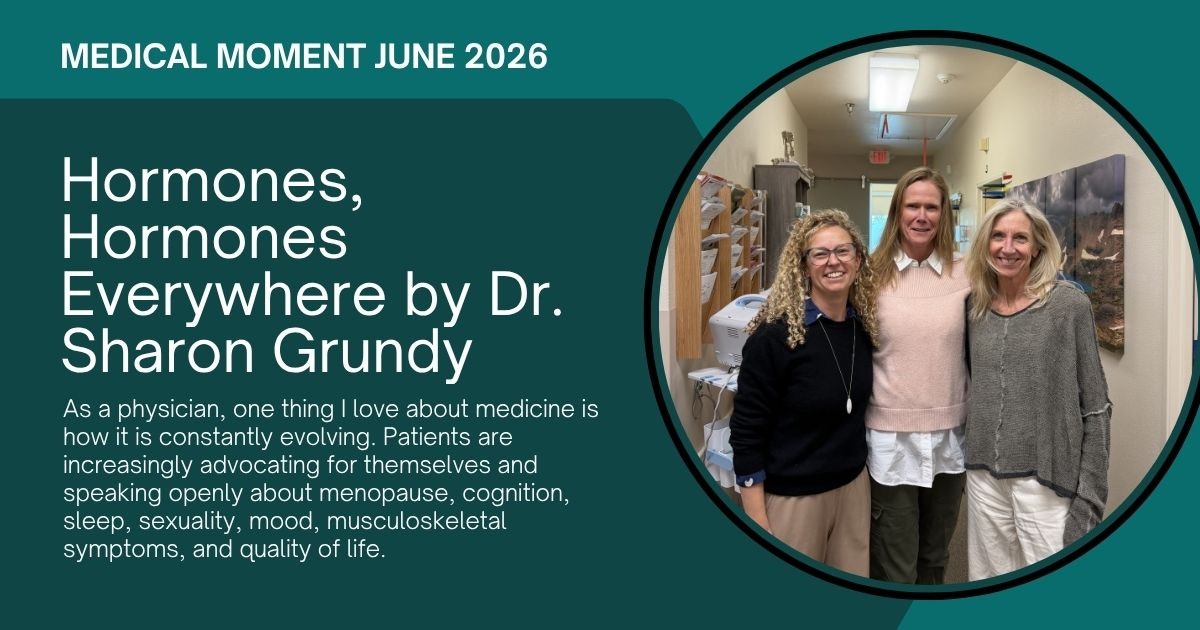
Hormones, Hormones Everywhere by Dr. Sharon Grundy
Why does the topic of hormones suddenly seem to be everywhere?
As a physician, one thing I love about medicine is how it is constantly evolving. Patients are increasingly advocating for themselves and speaking openly about menopause, cognition, sleep, sexuality, mood, musculoskeletal symptoms, and quality of life. Clinicians are now being challenged to address menopause more comprehensively rather than simply encouraging women to “wait it out.”
I still see women whose menopausal symptoms and experiences have been minimized or dismissed. Yet in the United States, the average age of menopause is 51–52, while average female life expectancy approaches 80 years. Perimenopause often begins in the mid- to late 40s. This means many women spend more than one-third of their lives in peri- and post-menopause.
The primary hormones affected during this transition include estrogen, progesterone, and testosterone. Fluctuations and decline in these hormones can impact many aspects of health and well-being. Despite this, mainstream medicine historically devoted limited attention to hormonal health after the reproductive years.
My own journey as a local primary care physician has been shaped by listening closely to patients and helping guide colleagues at Telluride Regional Medical Center toward evolving perspectives in women’s health. For many years after 2002, finding balanced, evidence-informed guidance on HRT — especially for perimenopausal women — was surprisingly difficult.
To better understand this field, I explored educational resources from organizations such as Institute for Functional Medicine, WorldLink Medical, and American Academy of Anti-Aging Medicine, alongside more traditional medical literature. My curiosity grew as I observed many patients who either chose to remain on HRT or sought care elsewhere reporting improvements in energy, musculoskeletal comfort, sexual health, sleep, and overall quality of life.
In recent years, organizations such as The Menopause Society and American College of Obstetricians and Gynecologists have also shifted toward more proactive discussions around menopause symptoms and treatment beyond “the lowest dose possible, the shortest amount of time”.
I am proud that our providers at Telluride Regional Medical Center are embracing these conversations. I believe menopause and perimenopause care belong within primary care — family medicine and internal medicine practices — and that women should not necessarily need to seek out a separate “hormone specialist” to begin these discussions.
Emily McGough, FNP-BC is currently becoming a Menopause Society Certified Practitioner, and Laura Cattell, MS PA-C is pursuing advanced hormone education through WorldLink Medical. Additional providers within our practice are also expanding their education in this area, and patients can be referred for more in-depth consultations when appropriate.
Perimenopause and menopause therapy are never “one size fits all.” Perimenopause often involves unpredictable hormone fluctuations, while menopause treatment tends to be more standardized — though every woman metabolizes and responds to hormones differently. Individualized care matters.
If you have questions about menopause or are interested in learning more, we are here to help. I often remind women that this is a journey, and it may take time — and sometimes multiple visits — to determine the right approach based on age, symptoms, health history, risk factors, and personal goals.
Importantly, this care should not be financially out of reach. Many hormone therapies are covered by insurance or are available at relatively modest cost, and extensive laboratory testing is not always necessary.
One of the best places to start is simply discussing menopause during your annual preventive visit. The goal is to establish a trusted relationship with a provider who can help guide you through this stage of life with evidence-based, individualized care.
Your health matters.
Dr Sharon Grundy
__________________________________________________________________________
Junio 2026
Hormonas, hormonas por todas partes. Escrito por la Dra. Sharon Grundy
¿Por qué de repente parece que el tema de las hormonas está en todas partes?
Como doctora, una de las cosas que me encanta de la medicina es que está en constante evolución. Cada vez más pacientes abogan por su propia salud y hablan abiertamente sobre menopausia, cognición, dormir, sexualidad, estado de ánimo, síntomas de los músculos y huesos y calidad de vida. Ahora se está desafiando a los médicos a abordar la menopausia de forma más integral en lugar de simplemente pedirles a las mujeres que "esperen".
Sigo viendo mujeres cuyos síntomas y experiencias menopáusicas han sido minimizados o descartados. En Estados Unidos, la edad media de la menopausia es de 51 a 52 años, mientras que la esperanza de vida media de las mujeres se acerca a los 80 años. La perimenopausia suele comenzar entre mediados y finales de los 40, lo que significa que muchas mujeres pasan más de un tercio de su vida en peri y postmenopausia.
Las principales hormonas afectadas durante esta transición incluyen el estrógeno, la progesterona y la testosterona. Las fluctuaciones y el declive de estas hormonas pueden afectar muchos aspectos de la salud y el bienestar. A pesar de ello, la medicina convencional históricamente dedicó poca atención a la salud hormonal pasado los años reproductivos.
Mi propio camino como médica de atención primaria local se ha moldeado al escuchar atentamente a los pacientes y al guiar a mis colegas de la clínica de Telluride hacia perspectivas cambiantes en la salud de la mujer. Durante muchos años, después de 2002, encontrar una guía equilibrada y basada en evidencia sobre el tratamiento de reemplazo hormonal (TRH) —especialmente para mujeres perimenopáusicas— resultó sorprendentemente difícil.
Para comprender mejor este campo, exploré recursos educativos de organizaciones como el Institute for Functional Medicine, WorldLink Medical y American Academy of Anti-Aging Medicine, junto con literatura médica más tradicional. Mi curiosidad creció al observar a muchos pacientes que optaron por seguir con el TRH o buscaron atención médica en otro lugar e informaron mejoras en energía, bienestar musculoesquelético, salud sexual, sueño y calidad de vida en general.
En los últimos años, organizaciones como The Menopause Society y el American College of Obstetricians and Gynecologists también han optado por debates más proactivos sobre los síntomas y el tratamiento de la menopausia, más allá de "la dosis más baja posible, el menor tiempo posible".
Me enorgullece que nuestros profesionales de la clínica de Telluride estén participando en estas conversaciones. Creo que la menopausia y la atención de la perimenopausia pertenecen a la atención primaria — medicina familiar y medicina interna — y que las mujeres no deberían necesariamente buscar a un "especialista hormonal" para iniciar estas conversaciones.
Emily McGough, FNP-BC, estará en breve certificada por la Menopause Society, y Laura Cattell, MS PA-C, está realizando estudios avanzados en hormonas a través del WorldLink Medical. Otros profesionales de nuestro consultorio también están ampliando su formación en esta área, y los pacientes pueden ser derivados a consultas más profundas cuando sea apropiado.
La terapia para la perimenopausia y para la menopausia nunca son "iguales para todos". La perimenopausia suele implicar fluctuaciones hormonales impredecibles, mientras que el tratamiento de la menopausia tiende a ser más estandarizado, aunque cada mujer metaboliza y responde a las hormonas de forma diferente. Así, la atención individualizada importa.
Si tiene preguntas sobre la menopausia o le interesa saber más del tema, estamos aquí para ayudarle. A menudo les recuerdo a las mujeres que esto es un viaje, y que puede llevar tiempo —y a veces varias citas— para determinar el enfoque adecuado en función de la edad, los síntomas, el historial médico, los factores de riesgo y los objetivos personales.
Es importante destacar que este cuidado no debería estar fuera del alcance económico. Muchas terapias hormonales están cubiertas por los seguros médicos o están disponibles a un costo relativamente modesto, y no siempre es necesario realizar análisis de laboratorio exhaustivos.
Uno de los mejores lugares para empezar es simplemente hablar sobre la menopausia durante su visita preventiva anual. El objetivo es establecer una relación de confianza con un profesional que pueda ayudarle a atravesar esta etapa de la vida con una atención individualizada basada en la evidencia.
Su salud importa.
Dra. Sharon Grundy